SEO Isn’t Dead. Long Live GEO (Generative Engine Optimization).
Jun 03 2025 / 6 min
For more than 20 years, the search for a supplier almost always started in the same place: Google. A prospect would type in a few keywords, browse a list of links, and click yours.
Today, that same prospect asks ChatGPT, Copilot, or Google directly. They get a ready-made answer: a summary that compares options, names a few suppliers, and suggests a course of action. Often without clicking a single link.
The question is no longer just “Can people find us?” but also “Does AI talk about us, and what does it say?” That’s what GEO is all about.
The good news: the SEO work you’ve done isn’t wasted. Quite the opposite. Here’s why.
What Is GEO?
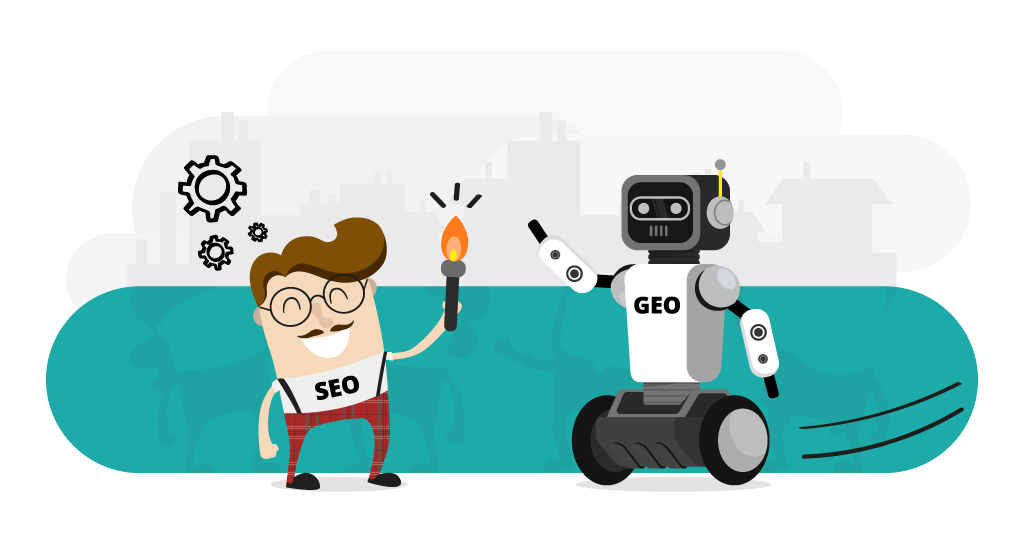
GEO (Generative Engine Optimization) means optimizing your content to increase the chances that it will be understood, cited, and recommended in AI-generated answers.
The term comes from an academic study published in 2024, which found that certain optimizations can increase a piece of content’s visibility in these answers by up to 40%.
Results vary depending on the tool, how the question is phrased, and the user. No method can guarantee that AI will cite your page, but you can stack the odds in your favor.
SEO Isn’t Dead. It’s Just Not Enough Anymore.
In 2024, Gartner predicted a 25% decline in traditional search volume by the end of 2026. We’ve reached that point, and Google is still here. What has changed is that AI has become part of the search engine itself.
- Google’s AI Overviews have more than 2.5 billion users per month, while AI Mode has more than one billion (Google I/O 2026).
- 38% of pages cited in AI Overviews also rank in Google’s top 10 for the same query, compared with 76% a year earlier (Ahrefs, 2026).
- Around 60% of searches now end without a click to a website (Bain & Company, 2025).
These figures tell us two things.
First, organic search still matters, but the playing field is broader. To build an answer, AI breaks a question down into several sub-questions and looks for sources for each one. Ranking well for a keyword is no longer enough: you also need to answer the related questions your customers are asking.
Second, appearing on Google, even in an AI-generated answer, no longer guarantees a visit to your website: people sometimes settle for the answer displayed. What that answer says about you is now just as important as where you rank.
SEO helps people find you. GEO gets you cited. The two work hand in hand.
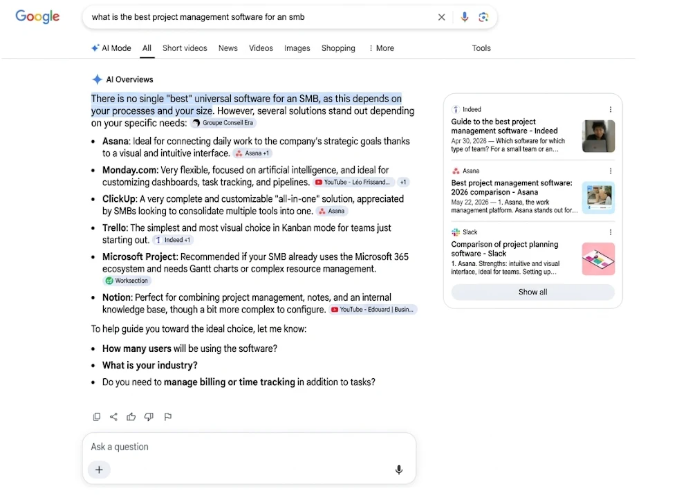
Caption: Users get a complete recommendation, backed by sources, without leaving Google.
SEO, AEO, GEO: What’s the Difference in Practice?
Consider the operations director of a manufacturing SME looking for a CRM. The discipline that comes into play depends on how they search.
- SEO (Search Engine Optimization). They type “CRM for manufacturing SMEs” into Google and get a list of links. The goal: rank as high as possible for the right keywords.
- AEO (Answer Engine Optimization). They ask Google, “How do you choose a CRM for a manufacturing SME?” and get a direct answer at the top of the results, in the form of a featured snippet or AI Overview. The goal: have your content used as the answer, with your website cited as the source.
- GEO (Generative Engine Optimization). They ask ChatGPT: “I run a 50-employee manufacturing SME that uses SAP. Which CRM should we choose to better manage our sales and customer service?” AI draws on multiple sources and generates a tailored recommendation. The goal: be included in that recommendation and, ideally, be cited as a source.
With GEO, your website is no longer just a destination. It becomes a trusted source that AI draws on to formulate its answers.
In practice, you don’t choose between the three. The strongest strategies combine them in a hybrid approach, sometimes called AIO (AI Optimization).
Why It Matters in B2B Marketing
In B2B, buying cycles are long, decisions involve several people, and every buyer does their homework before speaking with a supplier. Increasingly, they’re doing that homework with AI.
- 94% of B2B buyers use AI in their purchasing process, up from 89% a year earlier (Forrester, 2026).
- Nearly 9 out of 10 organizations regularly use AI in at least one business function (McKinsey, 2026).
- In Quebec, our study of 211 B2B companies shows that 83% are already using AI. Yet 44% are only just discovering the concept of GEO.
At Bang, we remember exactly when it clicked for us. On November 12, 2024, we identified our first lead referred by generative AI. This prospect hadn’t found us on Google. AI had recommended us.
As we’ve seen, many prospects no longer make it to your website. But when they do, they’re already further along in their journey, well-informed, and have a shortlist in mind. In other words, they start without you. The result: less traffic, but more qualified traffic. Your website therefore needs content that helps people evaluate their options, not just learn about them.
How to Get Cited by AI: The 3 Key Levers
Three levers influence whether AI talks about you: what you write, how your website is built, and what others say about you.
- Content. Directly answer your customers’ real questions, the ones they ask online or bring to your sales reps (your sales calls are a gold mine). When it comes to format, think of the 3 Cs:
- Clarity: Put the answer first and organize your content with clear headings and tables.
- Credibility: Back up your statements with up-to-date data and reliable sources.
- Cite-worthiness: Make sure each section can stand on its own. AI extracts passages, not entire pages.
- Technical foundations. Schema.org markup (Article, FAQPage, Organization) helps search engines understand what each page contains. A clear architecture, organized into semantic content clusters, does the rest.
- Brand authority. AI systems place more trust in what others say about you than in what you say about yourself. They favor brands mentioned across several reliable sources: industry media, associations, partners, and experts with a visible presence on LinkedIn.
Original data is a great shortcut. A survey of your customers, an analysis of your own data, or an industry study can give you figures nobody else has. The media, your peers, and AI then have a good reason to cite you: you’re the only source of that information.
Credibility also matters to people, because buyers don’t blindly trust AI. According to Forrester, they find its answers fast, but often incomplete. So they validate them with sources they trust: colleagues, peers, and brands they know. Being recommended by AI opens the door. Your credibility does the rest, which is why it’s important to build a brand that reassures buyers.
Ready to take action? Our guide, Master AI to Get Cited and Build Influence, breaks down each of these levers.
How Can You Tell Whether AI Is Citing You?
There’s no such thing as “Google Analytics for GEO” yet. In fact, half of the Quebec B2B companies surveyed in our study say GEO’s impact is impossible to measure for now. Measurement is still imprecise and unreliable: several AI tools don’t pass referral information to your website or encourage clicks. Still, here are a few ways to get started:
- Make a list of 5 to 10 real questions your customers ask.
- Ask ChatGPT, Gemini, Copilot, and Google those questions every month, ideally using an account with no search history.
- Record whether your brand is cited as a source (1 point), simply mentioned (0.5 points), or absent (0 points). Do the same for 3 to 5 competitors.
- Check whether AI describes your offering accurately and what tone it uses.
- Keep an eye on your traffic data: in Google Analytics, look for visits identified as coming from AI tools, while remembering that this is only the tip of the iceberg.
- Add a simple question to your forms or sales calls (“How did you hear about us?”) to capture mentions your dashboards can’t track.
If AI describes you poorly, it’s often a sign that your positioning isn’t clear enough.
Is Your Content GEO-Ready? Take the Test.
- My content answers a real question my customers have.
- The answer appears in the opening lines, without unnecessary jargon.
- Each section stands on its own (descriptive headings, short paragraphs).
- I support my statements with up-to-date data, examples, or sources.
- The content is attributed to an identified expert.
- I’ve included at least one enhanced format (FAQ, table, or visual).
- The page uses the appropriate Schema markup.
- My brand is described consistently on my website, LinkedIn, and industry directories.
Fewer than 6 boxes checked? You know where to start.
Key Takeaways
SEO isn’t dead. It remains the foundation of your online visibility, including in AI-generated answers. GEO helps ensure that AI talks about you, and says the right things.
Do you know what AI says when someone asks about your company? That’s exactly what we analyze as part of our GEO services. Let’s talk.
Want to start with the basics? The replay of our introductory GEO webinar is still available.
Quick FAQ: GEO in Five Questions
Is GEO Only for Large Companies?
No. AI favors specialized, credible sources, not necessarily the biggest ones. An SME that becomes the go-to authority in a specific niche can outperform a major player on that topic.
Do I Need to Rewrite All My Content?
No. Start with the pages that matter most to your sales. To choose them, ask five questions about each one: Does it answer a real customer question? Is your expertise distinctive? Can it provide a clear, factual answer? Can it be cited on its own? Does it have a real impact on sales? Any page with at least four “yes” answers should be prioritized for optimization.
How Long Does It Take to See Results?
Allow a few months. AI systems rely in part on search engine indexes and your brand’s reputation, both of which take time to build. Like SEO, GEO is a medium-term investment.
Do AI Systems Actually Read Schema Markup?
Google uses it to understand your pages and display rich results. For models such as ChatGPT, the effect is more indirect: markup reduces ambiguity and makes information easier to extract.
Do I Need to Publish More Content to Get Cited?
No. Clear, up-to-date, well-supported content is worth more than ten generic articles, especially when AI already has us all repeating ourselves. Don’t shout louder: be the source.
You may also like
AI Stole Your TOFU: Why Your B2B Website Needs Consideration Content (and How to Get Started)
Most B2B websites are built to educate. Explain what you do, publish introductory articles, answer the basic questi[...]
Web
May 19, 2026
/5 min
AI isn’t killing your B2B marketing. It’s exposing what was never clear.
A few months ago, a marketing director at a manufacturing SMB asked us a question we’re hearing more and more[...]
Strategy
Feb 23, 2026
/4 min
How to Get Cited by AI: GEO for B2B Marketers
Let’s be honest: how many times this week have you opened ChatGPT, Copilot, or Perplexity to look something up? A d[...]
Content marketing
Web
Nov 4, 2025
/7 min